EV Infrastructure Mandates

EV Mandates by North American Cities: A Practical Guide for Developers & Architects
EV mandates are reshaping parking design, electrical infrastructure planning, and long-term asset strategy across North America. City-by-city regulations vary widely, but the direction is consistent: more EV-capable parking, higher electrical loads, and greater pressure to future-proof facilities.
For developers and architects, understanding EV mandates early in the design phase reduces costly redesigns and positions projects to remain compliant as regulations tighten. This guide outlines how major cities are approaching EV infrastructure requirements and what those mandates mean for parking and building design.
San Francisco: Some of the Most Aggressive EV Mandates in the U.S.
San Francisco enforces the most comprehensive EV mandates in the country. All new developments must make 100 percent of parking spaces EV-capable, including conduit and panel capacity. Ten percent of spaces must have operational chargers installed at delivery, and 20 percent must be designated EV-ready.
The city has also secured $15 million to deploy 300 new chargers in municipal garages and lots. Combined with its goal of a fully zero-emission bus fleet by 2035, these policies significantly increase electrical load requirements and intensify the challenge of fitting compliant parking into dense urban footprints.
New York City: Multi-Layered EV Infrastructure Requirements
New York City applies a tiered approach to EV mandates. New developments must install Level 2 chargers in 20 percent of parking spaces and make 60 percent EV-ready. DC fast charging can replace some Level 2 chargers, but substitutions are capped at 50 percent.
Citywide initiatives reinforce these requirements. The New York Power Authority is developing 18 fast-charging hubs at municipal sites, and the Taxi and Limousine Commission requires high-utilization fleets to transition to EVs by 2030. These mandates directly affect electrical service sizing, transformer placement, and parking layouts in both private and public projects.
Boston: EV Mandates Focused on Universal Access
Boston requires EV chargers in 25 percent of new parking spaces, with the remaining 75 percent built EV-ready. The city’s objective is to place charging stations within a five-minute walk of every resident.
Municipal fleet electrification and the transition of public school buses to electric vehicles add sustained demand for charging infrastructure. For developers, Boston’s EV mandates signal long-term reliance on parking facilities that can support expanding electrical loads without disruptive retrofits.


Los Angeles: Tiered EV Compliance with Future-Facing Signals
Los Angeles mandates that 35 percent of new parking spaces be EV-capable, 25 percent EV-ready, and 10 percent equipped with operational Level 2 chargers.
The city is also testing wireless charging along a half-mile corridor in Westwood ahead of the 2028 Olympics. While still experimental, this pilot highlights how charging technology may evolve and further complicate traditional parking design assumptions. Current EV mandates already require substantial investments in electrical infrastructure and phased construction planning.
Toronto: EV Mandates Under the TransformTO Program
Toronto’s EV mandates require 10 percent of parking spaces in new developments to include installed Level 2 chargers, with an additional 40 percent built EV-capable. These requirements support the city’s TransformTO strategy, which targets net-zero emissions by 2040.
The combined 50 percent EV infrastructure commitment increases upfront costs related to conduit runs, electrical rooms, and panel capacity. Developers must weigh immediate compliance against the likelihood of stricter future mandates.
Philadelphia: Modest EV Mandates with Clear Upward Pressure
Philadelphia currently requires 10 percent of parking spaces to include EV chargers at delivery, with no EV-ready requirement for the remaining spaces. While less aggressive than peer cities, the policy leaves little margin for future growth.
The city plans to expand its municipal EV fleet from 400 to 1,000 vehicles, increasing demand for overnight and centralized charging. Developers planning long-term assets face a choice: build to minimum requirements or anticipate future EV mandates and market expectations.
San Diego: EV Mandates in Transition
San Diego requires new developments to include 10 percent EV-capable spaces, 5 percent EV-ready spaces, and 1 to 2 percent with installed chargers.
While these numbers are lower than in other California cities, the Climate Action Plan points to rapid escalation. San Diego aims for a fully electric light-duty municipal fleet and complete school bus electrification by 2035. Developers who only meet today’s minimums may face costly retrofits as standards tighten.


Miami: EV Infrastructure Without Mandates
Miami currently has no enforceable EV mandates for private developments after state lawmakers overturned a prior 20 percent EV-ready requirement.
Despite the absence of regulation, EV adoption continues to grow. Charging access increasingly influences tenant and buyer decisions. In this market, EV infrastructure is a competitive differentiator rather than a compliance exercise, particularly in mixed-use and multifamily developments.
Atlanta: Public vs. Private EV Mandates
Atlanta requires 20 percent EV-ready spaces in new commercial developments, while city-owned facilities must support 50 percent EV charging capacity.
This gap reflects where the city expects private-sector standards to move. Developers who align their projects with municipal benchmarks can reduce future compliance risk and strengthen long-term asset value.
Addressing EV Mandates with Automated Parking Solutions
EV mandates across major cities are increasing design complexity. Higher electrical loads, larger conduit networks, and space constraints make traditional parking structures more expensive and less flexible over time.
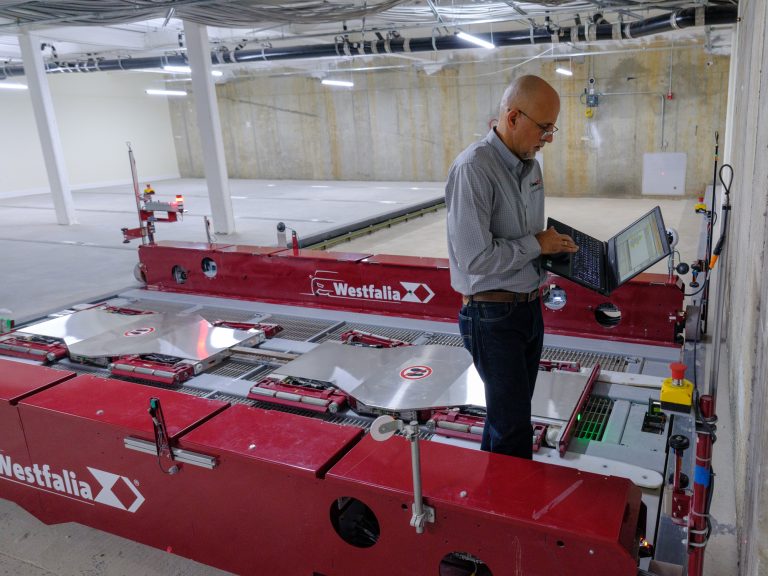
Westfalia Technologies helps developers address these challenges with automated parking systems designed to integrate EV charging at every parking position. Westfalia’s WePlug automated charging solution removes the limitations of fixed charging stations and enables scalable, centralized EV infrastructure.
By combining automated parking with intelligent charging, developers can meet or exceed current EV mandates, adapt to future regulatory changes, and reduce the overall footprint and cost of parking facilities.
To learn how automated parking can simplify EV mandate compliance and future-proof your project, contact the experts at Westfalia Technologies.