What Actually Makes an Automated Parking System Reliable

Ask any developer, architect, or facility owner what worries them most about automated parking, and reliability tops the list almost every time. It’s a fair concern. A parking system isn’t a convenience feature, it’s infrastructure. If it goes down, residents can’t get to work, a hotel can’t valet for guests, a retail garage can’t turn over spaces. The stakes are high enough that “will it actually work, every day, for the next 20 years” deserves a real engineering answer, not a marketing one.
That answer has very little to do with luck, and everything to do with a specific set of design and manufacturing disciplines. Reliability in automated parking, like reliability in any piece of industrial automation, is a property you engineer in from the first schematic, not something you hope for after installation. This piece walks through what that actually looks like: the component choices, the mechanical and electrical design practices, the software architecture, and the organizational structure behind the companies that build these systems, since that structure turns out to matter as much as any single part.
Reliability Is a Measurable Engineering Target, Not a Feeling
Before getting into what drives reliability, it’s worth being precise about what the word means. In industrial automation, reliability is usually expressed through a few concrete metrics: availability (the percentage of time a system is operational and able to perform its function), mean time between failures (MTBF, how long a system typically runs before something breaks), and mean time to repair (MTTR, how quickly a failure can be diagnosed and resolved once it happens).
This distinction matters because a system can have a very high MTBF and still feel unreliable if its MTTR is long, e.g. a rare failure that takes two days to fix will frustrate users far more than a slightly more frequent one that resolves in twenty minutes. Good reliability engineering treats both halves of that equation as design problems: reduce how often things fail and reduce how long it takes to recover when they do. Everything else in this article flows from that framing.
Decades of Automation Experience, Applied to a New Problem
Automated parking is a relatively young application, but the underlying technology is not. The pallets, shuttles, lifts, and control systems used in automated parking share a direct lineage with automated storage and retrieval systems (AS/RS) that have been running in warehouses and distribution centers, often in continuous, three-shift operation, for well over half a century. That matters because reliability engineering is cumulative: a company that has spent decades refining motor selection, rail tolerances, control logic, and fault-handling routines for high-cycle material handling equipment brings a much deeper base of field data and failure analysis to a parking application than an organization building its first automated structure from scratch.
This is one of the more underappreciated points in evaluating automated parking: the quality of a system has less to do with how long automated parking itself has existed and more to do with how long the organization behind it has been solving the much broader problem of moving heavy objects precisely, repeatedly, and safely with a machine.
Component Selection: Industrial-Grade, Not Commercial-Grade
Every automated parking system is really an assembly of motors, drives, sensors, bearings, rails, and fasteners, and the reliability of the whole system is capped by the weakest of those parts. This is where the gap between a well-engineered system and a poorly engineered one often starts, long before a single line of software is written.
Components rated for industrial duty cycles, i.e. motors sized with margin rather than run at their limit, variable frequency drives built for continuous operation, bearings and gearboxes specified for the actual load and cycle count the system will see over 20 to 30 years, etc., cost more up front than consumer or light-commercial equivalents, but they fail far less often and far more predictably. Enclosures and electrical components need an appropriate IP (ingress protection) rating for the environment they’ll actually sit in, since a parking structure potentially sees moisture, temperature swings, and in many climates, airborne salt and road grime that would degrade under-specified hardware within a few years.
Sensing is just as important as the moving parts themselves. Modern parking safety standards call for redundant sensing devices, for example, presence and position detection built to recognized safety-rated performance levels, not a single commodity sensor¹, specifically because a sensor failure that goes undetected is far more dangerous and disruptive than almost any mechanical failure. A system designed around this principle uses multiple, independent ways of confirming a vehicle’s position, a pallet’s location, and a door or barrier’s state, so that one failed sensor doesn’t halt the system (or worse, let it proceed incorrectly).
Mechanical and Electrical Design for Low Downtime
Component quality only pays off if the surrounding mechanical and electrical design gives those components a fair chance to do their job. A few principles separate systems built for decades of reliable service from those that aren’t.
Structural tolerances and redundancy. Recognized safety standards for power-driven parking equipment require that load-bearing suspension elements, i.e. the cables, chains, or other lifting elements that carry a vehicle’s weight, be independently redundant, typically requiring at least two mutually independent suspension elements with a built-in safety factor on breaking strength several times higher than the maximum possible load.¹ That kind of structural margin isn’t about meeting a minimum legal bar; it’s a direct, physical hedge against a single-point failure ever stopping the system or endangering a vehicle.
Interlocking and fail-safe mechanical logic. Well-designed systems use mechanical interlocks (overspeed governors, locking devices, and positive-opening safety switches¹ ) that physically prevent two things from moving into conflict with each other, rather than relying solely on software to catch a timing error. This layered approach (mechanical safeguard plus control logic plus sensor confirmation) is what allows a system to fail safely instead of failing destructively.
Electrical robustness. A parking structure’s electrical environment is “noisy”: large motors starting and stopping, nearby building systems, and in many cases EV chargers drawing variable loads. Control systems need to be designed and tested for electromagnetic compatibility¹, so that electrical noise from the building doesn’t cause spurious faults or, worse, undetected ones. Backup and surge-protected power for control electronics, properly rated circuit protection, and clean separation between power and signal wiring all reduce the number of “ghost” electrical faults that are disproportionately time-consuming to diagnose.
Accessibility for maintenance. A mechanically brilliant system that requires removing half the structure to service a worn bearing will rack up downtime regardless of how rarely that bearing fails. Designing service access into the structure from day one, and not as an afterthought, is a frequently overlooked contributor to low MTTR.
Software Written to Minimize Downtime
As automated parking systems have matured, software has become as important to reliability as the steel and motors. A few practices distinguish software built with uptime as a primary design goal.
Fault isolation by design. The control software should be architected so that a single malfunctioning component, e.g. one sensor, one drive, one laser, doesn’t bring down the entire system. Modular, zone-based control logic allows a system to take one problem area offline for service while continuing to park and retrieve vehicles everywhere else, which is often the single biggest difference between a brief service interruption and a system-wide outage.
Continuous self-monitoring. Rather than waiting for a failure to announce itself, well-designed systems monitor sensor and actuator health continuously and flag degrading performance, such as a motor drawing more current than it should, a cycle taking longer than its baseline, a sensor returning inconsistent readings, etc. before it becomes an outright failure. Parking safety standards already require certain safety-related faults to be automatically detected before a movement is allowed to proceed¹; the best commercial software extends that same philosophy to non-safety-critical performance monitoring, turning maintenance from reactive to predictive.
Clear, structured diagnostics. When something does fail, how quickly a technician can find the root cause depends heavily on what the software tells them. Systems that log detailed event histories, timestamp every fault condition, and present diagnostics in plain language (rather than a generic error code) cut MTTR dramatically compared to systems that leave a technician guessing.
Remote visibility. Telemetry that lets a system’s performance be monitored off-site, ideally by the same engineering organization that designed the system, means problems can often be caught, and in some cases resolved, before anyone on site even notices an issue.
Designing for Fast Fault Recovery
No automated system, no matter how well built, will run for 20 years without ever encountering a fault. The measure of a mature design isn’t the absence of faults: it’s how quickly and gracefully the system recovers from them. This shows up in a few concrete design choices.
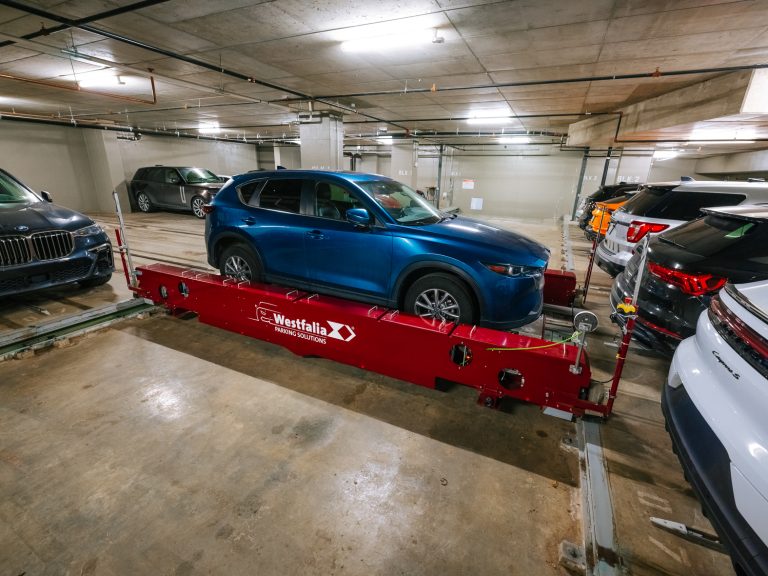
Redundant travel paths and multiple vehicle moving devices, where the system’s layout allows, mean that a single stuck transfer car or pallet doesn’t necessarily take the whole structure offline. Manual override and backup retrieval procedures, built into the system from the start rather than improvised after the fact, ensure a vehicle can still be retrieved even in the rare case of a significant fault, which matters enormously to user confidence. Field-replaceable, modular components such as a drive, a sensor module, a control card that can be swapped in minutes rather than requiring a multi-day repair, turn what could be an extended outage into a short service call. And a well-managed spare parts strategy, with critical components stocked regionally rather than ordered after a failure occurs, is often the difference between an hour of downtime and a week of it.
Integrating Software Across Different Systems: and Why It’s Harder Than It Looks
Here’s a part of the reliability picture that gets far less attention than it deserves: a surprising amount of real-world APS downtime doesn’t come from any single component failing. It comes from the seams between systems that were never designed to work together in the first place.
A great many automated parking installations are assembled by a systems integrator: a company that purchases conveying equipment and lifting mechanisms from one supplier, a PLC and control hardware from another, and either writes or subcontracts a software and user-interface layer to tie it all together. Each piece may be perfectly good on its own. The problem is what happens at the boundaries: communication protocols that don’t quite agree on timing, a software update from one vendor that assumes a hardware revision the integrator hasn’t installed yet, or a fault whose root cause sits ambiguously between the mechanical supplier’s scope and the controls supplier’s scope. When something goes wrong in that kind of system, the first job isn’t fixing it. It’s figuring out which vendor’s responsibility it is, and that alone can add days to a repair.
This is precisely where vertically integrated manufacturers, companies that engineer the mechanical structure, design the electrical and control systems, and write their own software in-house, under one roof, have a structural advantage that has nothing to do with marketing and everything to do with how reliability engineering actually works. When one organization owns the full stack, a few things become possible that simply aren’t when three or four companies are involved.
A single point of accountability. There’s no ambiguity about who diagnoses a fault or who’s responsible for fixing it, because the same organization designed every layer of the system. That alone can cut root-cause diagnosis time substantially compared to a multi-vendor environment.
A genuine feedback loop between field performance and design. When the engineers who support installed systems in the field are the same organization, very often the same people, who design the next generation of hardware and software, failure data flows directly back into design improvements.
Faster, more coordinated software updates. A control software fix doesn’t have to wait on a third-party supplier’s release schedule, compatibility testing across vendor boundaries, or a change order process between companies. The team that wrote the control logic can diagnose a field issue and ship a fix without a negotiation.
Consistent engineering standards across the whole system. Tolerances, safety margins, and testing protocols are set once, by one engineering organization, rather than inherited piecemeal from whichever suppliers happened to be sourced for a given project. That consistency is itself a reliability factor. It’s much harder for a mismatch in assumptions to create an unanticipated failure mode when one team made every assumption.
None of this means every system assembled by an integrator is unreliable, or that every vertically integrated manufacturer is flawless as execution still matters enormously within either model. But it does mean the organizational structure behind a system is a legitimate engineering question, not just a procurement preference.
Other Factors Worth Asking About
A handful of additional practices separate the most reliable automated parking systems from the rest, and they’re worth raising directly with any provider.
Factory and simulation testing before installation. Systems that are modeled and stress-tested, including, increasingly, through digital-twin simulation of the full structure and control logic, before they’re ever installed on site catch a meaningful share of design issues before they become field failures.
Formal commissioning and acceptance testing. Recognized safety standards for this equipment require documented testing at installation and commissioning, not just at the factory.¹ A provider that treats this as a genuine engineering milestone, rather than a formality, is less likely to hand over a system with latent issues.
Reliability-centered maintenance planning. Rather than servicing every component on a fixed calendar regardless of actual wear, mature maintenance programs are built around failure-mode analysis: understanding how each component actually fails, how much warning it gives before it does, and how severe the consequence is, then targeting inspection and replacement intervals accordingly.² This approach, well established in aviation and heavy industry, is directly applicable to parking automation and measurably improves both uptime and maintenance cost over a system’s life.
Standardized designs over one-off engineering. A system built from proven, repeated subassemblies that have been refined across many installations, will generally have fewer unknown failure modes than a fully custom design engineered for the first time on a single project. Novelty is often the enemy of reliability.
Long-term component lifecycle planning. An automated parking system needs to be serviceable for 20 to 30 years, which is longer than many electronic and mechanical components stay in production. Providers who plan for component obsolescence through long-term supplier agreements, designed-in component substitution paths, or maintaining their own parts inventory, spare building owners from a scramble to find parts for a 15-year-old control board.
Trained, accountable service technicians. The best-designed system still depends on the people maintaining it. A trained, well-supported technician network, ideally one with direct access to the system’s original design engineers rather than a general-purpose field service contractor, materially affects how quickly and correctly a repair gets made.
Compliance with recognized safety standards as a floor, not a ceiling. Standards covering the design, manufacturing, and commissioning of power-driven parking equipment set requirements for redundant safety sensing, mechanical interlocks, emergency stop systems, and electromagnetic compatibility.¹ These exist because the engineering community has already learned, often the hard way, what failure modes matter most. Treating compliance as the minimum starting point, rather than the goal, is a reasonable signal of how seriously a provider takes reliability generally.
Questions Worth Asking Before You Commit
For a developer or owner evaluating automated parking, a few direct questions tend to surface more useful information than a glossy spec sheet.
- Who designed the mechanical structure, who wrote the control software, and are they the same organization? If not, who is contractually responsible when a fault’s root cause is ambiguous between them?
- What is the system’s documented availability on comparable installations, and over what time period was it measured? A number without a timeframe or a comparable use case is hard to evaluate.
- How does the system isolate a fault: does one failed component take down a single zone, or the whole structure?
- What does the maintenance program actually consist of: fixed-interval servicing, or a failure-mode-based plan tailored to how each component actually wears?
- How are software updates delivered, and how long has it historically taken to resolve a reported software issue?
- What’s the plan for sourcing parts and supporting the control system in year 15 or year 20?
Conclusion
Reliability in automated parking isn’t a single feature or a single number. It’s the compounding result of dozens of engineering decisions, from the grade of bearing specified in a transfer car to the way a fault is isolated in software to the organizational structure of the company standing behind the system twenty years after installation. The systems that perform best over the long run tend to share a common thread: they were engineered by organizations with deep, cumulative experience in industrial automation, built from industrial-grade components with real redundancy, backed by software designed explicitly to isolate and recover from faults quickly, and, perhaps most importantly, supported by a single, accountable engineering organization rather than a patchwork of vendors meeting at a specification sheet. Asking the right questions about each of these layers, rather than taking an availability percentage at face value, is the best tool a developer or owner has for separating a system that will perform for decades from one that merely looks good in a proposal.
Sources
- BS EN 14010:2003+A1:2009, Safety of Machinery — Equipment for Power Driven Parking of Motor Vehicles — Safety and EMC Requirements for Design, Manufacturing, Erection and Commissioning Stages. European safety standard governing redundant suspension elements, mechanical interlocks, safety sensing, and electromagnetic compatibility for automated parking equipment.
- Reliability-centered maintenance (RCM) methodology, as established in aviation and industrial maintenance engineering practice, based on failure mode, effects, and criticality analysis.
Related reading: Automated Parking Technology Comparison · How Automated Parking Systems Work · Parking Without People: A Fire Code Primer on Fully Automated Parking Systems
Written by Ian Todd, EVP of Automated Parking at Westfalia Technologies, Inc.